
Tokyo Duty Free Prices Recalculated at September 2026's Won/Yen Rate: Still Worth Buying?
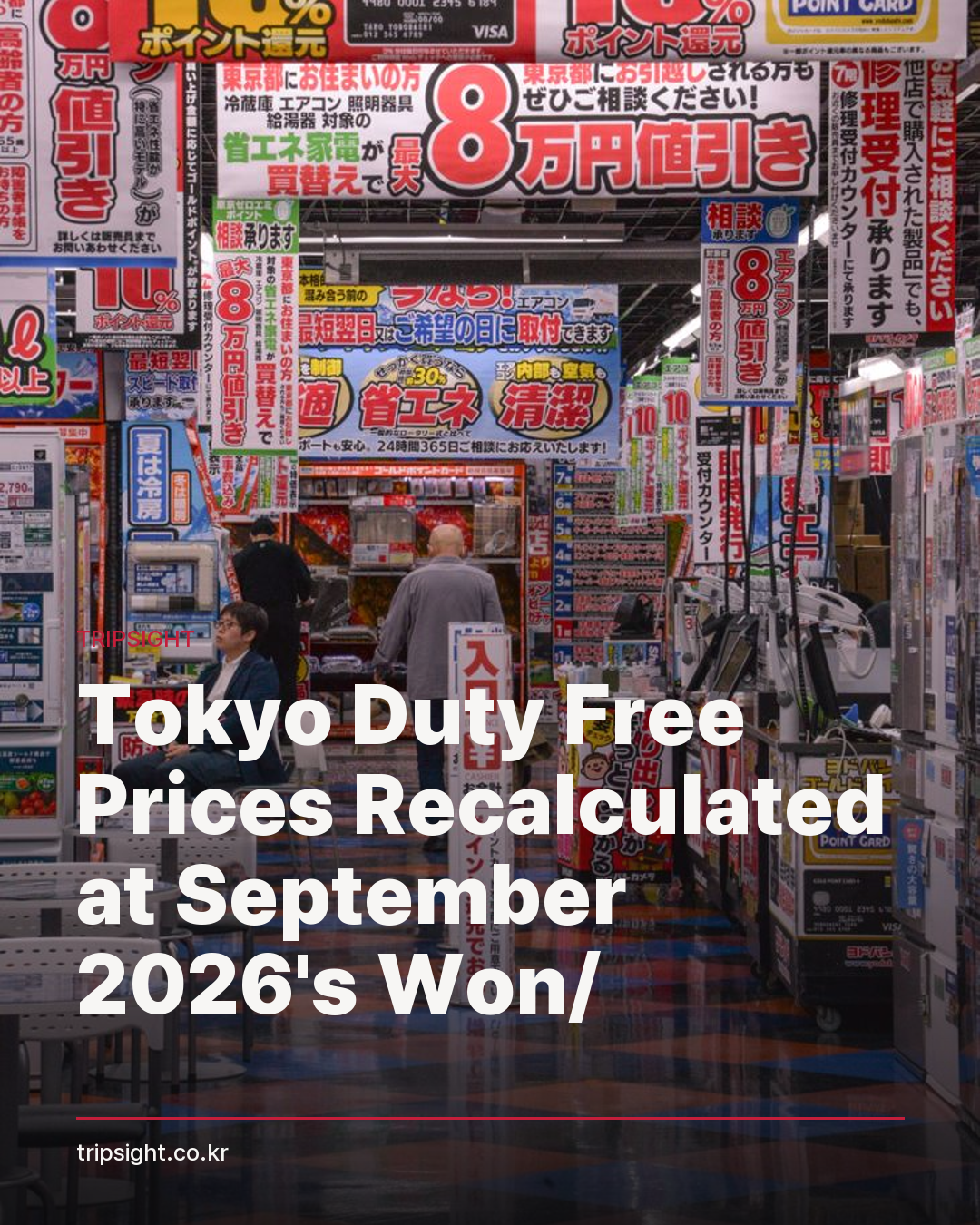
In September 2026, the won/yen base rate moved within a range of 857 to 871 won per 100 yen. The rate, which stood at around 857 won on September 2, climbed to 871.38 won by September 9. Recalculating Tokyo downtown duty free prices at this rate shows there are still items worth buying. That said, conditions apply: you need to buy above the consumption tax exemption floor (5,000 yen pre tax) while staying within Korea's basic duty free allowance (800 dollars) when entering the country.
Starting November 1, 2026, Japan's duty free system itself will shift from "instant exemption at purchase" to "refund at departure." A September trip is effectively the last season under the current system, where consumption tax is deducted right at the register.
What Is 100 Yen Worth in Won Right Now
The won/yen rate rose in early September 2026. At the base rate, 100 yen was worth about 857 won on September 2 and climbed to 871.38 won by September 9.
| Date (2026) | Won/Yen (per 100 yen) |
|---|---|
| September 2 | About 857 won |
| September 9 | 871.38 won |
This article uses the September 9 figure, 100 yen = 871.38 won (about 8.71 won per yen), for its conversions. Actual exchange rates will differ from this figure depending on the preferential rates offered by banks and currency exchange counters.
What Tax Gets Deducted at Tokyo Duty Free Stores
Japan's consumption tax is 10% for general items, with a reduced rate of 8% applied to certain items such as food and beverages. At downtown duty free stores, this consumption tax is deducted entirely from the sale price when a foreign traveler presents a passport and meets the required conditions.
According to Don Quijote's official guidance, eligible purchase amounts range from 5,000 yen to 500,000 yen before tax. Even if an individual item is under 5,000 yen, purchases of cosmetics, food, medicine, and similar items made at the same store on the same day can be combined, and if the total exceeds 5,000 yen, the exemption applies. The conditions are carrying the original passport and staying in Japan for tourism purposes.
- Purchases under 5,000 yen before tax: exemption does not apply, full tax included price must be paid
- Purchases from 5,000 yen to 500,000 yen before tax: discounted by the amount of consumption tax, combined purchases allowed
- Original passport required, and residency status must be for tourism purposes
The November 1 System Overhaul: What September Travelers Need to Know
Starting with purchases made on or after November 1, 2026, Japan's consumption tax exemption method will change. Until now, it has been an "exemption at purchase" system, where consumption tax is deducted immediately at the duty free store register. After the overhaul, it will become a "refund" system, where travelers first pay the full tax included price and then receive the consumption tax amount back after confirming the goods are being taken out of the country, such as at the airport upon departure.
The same overhaul also abolishes the 500,000 yen purchase cap that applied to so called "consumable goods" such as cosmetics, food, and medicine, integrating them with general items under the same rules.
Travelers visiting in September are still under the old system, so consumption tax is deducted immediately at the register, and no separate refund procedure is needed upon departure. However, those planning trips after November should keep in mind that the tax included amount will be charged first at the time of payment, and that an additional customs confirmation step at departure will be required to receive the refund.
Bringing It Back to Korea: Recalculating the 800 Dollar Limit
The Korea Customs Service's basic duty free allowance for travelers' personal belongings is 800 US dollars per person. This limit is calculated by combining items bought duty free in Tokyo with any duty free purchases made domestically or abroad. If the total does not exceed 800 dollars, you can enter the country without a separate declaration.
If the limit is exceeded, voluntarily declaring it allows a 30% reduction (up to 200,000 won) on the calculated customs duty, while failing to declare and getting caught results in a 40% surcharge.
Starting in July 2026, procedures were improved so that for duty free goods worth 800 dollars or less, exchanges can now be made domestically by mail or courier even without having declared the items upon entry. This may be worth keeping in mind if you buy multiples of an item in Tokyo at once, for instance to account for possible size exchanges.
The Conclusion, in a Conversion Table
Converting Tokyo duty free purchase amounts to won at 100 yen = 871.38 won (the September 9 figure) gives the following.
| Purchase amount (pre tax, yen) | Won conversion (approx.) | Exemption applies? |
|---|---|---|
| 1,000 yen | About 8,710 won | Below exemption floor, tax included price paid |
| 5,000 yen | About 43,600 won | Meets minimum exemption requirement, discounted by consumption tax |
| 10,000 yen | About 87,100 won | Exemption applies |
| 30,000 yen | About 261,400 won | Exemption applies, comfortable margin under the 800 dollar limit |
| 50,000 yen | About 435,700 won | Exemption applies, check whether combined purchases approach the 800 dollar limit |
To sum up, individual purchases under 5,000 yen before tax get no exemption benefit regardless of the exchange rate, so there is no gain in perceived price. Only when purchases of 5,000 yen or more are combined does the discount equal to the consumption tax carry through undistorted into the won conversion. The September exchange rate (100 yen = 857 to 871 won) represents a range where the won cost has increased compared to the period when the yen was weakest. Still, as long as you stay within the consumption tax exemption conditions and the 800 dollar limit, the math still works out in favor of shopping. If your trip falls after November 1, you should factor the added refund procedure into your itinerary.
Reference: Don Quijote official guidance on duty free procedures, eligibility, and eligible amounts
Reference: Korea Customs Service FAQ on the duty free scope for travelers' personal belongings
Reference: What is the duty free system reform: changes for 2025 and 2026 - freee
Reference: Won/yen (JPY100) exchange rate time series - INDEXerGO (checked 2026-09-09)